The Company Soul(.md)
Craig Bramscher
Why the first AI agent you build shouldn’t be an assistant
Craig Bramscher · Founder, Konmashi · June 2026
I’ve spent most of my life building organizations of one kind or another. Some were startups. Some were manufacturing companies. Today I split my time between running a property management company and building an AI software platform, which is either evidence of broad interests or proof that I never learned how to sit still.
Despite the different industries, the same challenge has followed me everywhere: how do you transfer what is in someone’s head into a system that can operate without them?
For years I believed that was primarily a management problem. Good leaders documented processes. Great leaders delegated. Exceptional leaders built systems that survived without them. At least that was the theory.
Then I spent the better part of a year experimenting with AI agents and realized something uncomfortable.
The problem was never management.
The problem was knowledge.
Like most people, I started where everyone starts. I installed agents. Lots of them. Every week seemed to bring another framework, another open-source project, another slick demo showing an army of digital workers transforming a business overnight. Installation was easy. The demos were impressive. Within minutes I could have an agent writing content, researching competitors, creating plans, or managing workflows.
The technology was remarkable.
The results were not.
What I discovered was that almost every agent platform asks some version of the same three questions.
Who are you?
What do you do?
What would you like me to do?
A few minutes later you’re staring at a blinking cursor and the promise of an AI employee.
The problem is that what you’ve actually created is a very enthusiastic intern with no context.
The agent doesn’t understand your business. It doesn’t know how decisions get made. It doesn’t know what matters and what doesn’t. It doesn’t know which customer complaints deserve immediate escalation and which ones are routine. It doesn’t know why your best salesperson consistently closes deals that everyone else loses. It doesn’t know why certain marketing campaigns work while others fail.
Most importantly, it doesn’t know what you know.
That sounds obvious until you realize something deeper.
Most of us don’t know what we know either.
Building Konmashi forced me to confront something I had spent decades overlooking. The knowledge that makes people valuable is often the knowledge they can no longer explain.
When we first learn a skill, every step is visible. We think consciously. We follow checklists. We can explain our reasoning. Then experience takes over and the steps begin to disappear.
The property manager glances at an owner email and instantly knows whether it’s routine, urgent, or potentially dangerous. The marketer can feel when a social post is going to miss before the metrics ever arrive. The salesperson knows exactly when to stop talking and let silence do the work.
Ask them how they know and you’ll often get a shrug.
They’re not hiding the process.
They’ve simply performed it so many times that the process itself has become invisible.
The irony is that the people who need leverage the most are usually carrying the highest amount of invisible knowledge. Founders, operators, managers, and experts are drowning in decisions they would love to delegate, but the very expertise that makes delegation valuable is the thing they struggle most to transfer.
This isn’t a new problem. It’s the reason companies have struggled with documentation for decades. It’s the reason institutional knowledge walks out the door when a key employee leaves. It’s the reason so many businesses become dependent on a handful of people who seem to know everything.
For years we’ve told people to document their processes.
Almost nobody does.
Partly because they’re busy.
Partly because documentation is tedious.
But mostly because it’s surprisingly difficult to describe something you’ve internalized.
Then I read Nate Jones’ article about creating a Soul.md file for an AI agent and something clicked.
I agreed with the premise completely, but I couldn’t stop thinking about it from the perspective of a business rather than an individual.
What if the soul doesn’t belong to the agent?
What if the soul belongs to the company?
The more I thought about it, the more obvious it became.
Every company already has a soul.
It’s hiding in thousands of conversations, hundreds of customer interactions, years of accumulated experience, unwritten rules, shared assumptions, and decisions nobody remembers making.
When we got involved with High Desert Property Management, I saw this firsthand. Like every successful business, there were hundreds of things people simply knew. Why certain owners required extra communication. Which tenant situations tended to escalate. How maintenance requests should be prioritized. Which marketing messages resonated with owners and which ones fell flat.
Some of that knowledge lived in SOPs.
Most of it didn’t.
It lived in people.
The same thing is true in every business. The roofing company that consistently wins competitive bids. The dental practice that creates loyal patients. The real estate brokerage that attracts top agents. The local manufacturer that somehow keeps customers for decades.
They all know things that aren’t written down.
Those businesses have a soul whether they realize it or not.
The challenge is that the soul is fragmented across dozens of people and thousands of decisions.
That’s where I think the next generation of AI agents will emerge.
Not as assistants.
Not as writers.
Not as strategists.
At least not initially.
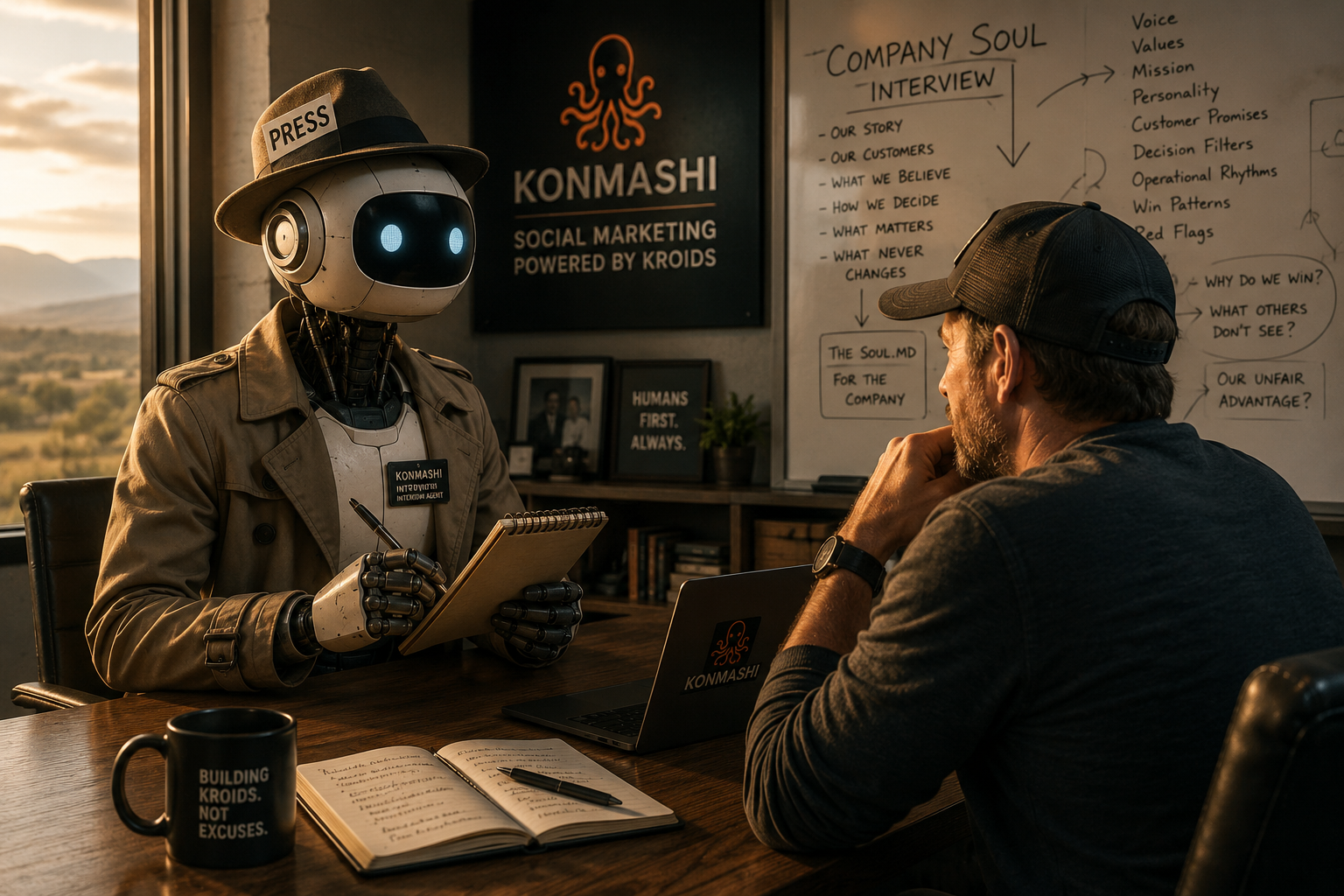
The first agent worth deploying may actually be an interviewer.
A patient, persistent interviewer whose sole purpose is extracting the knowledge a company already possesses.
Imagine an agent that sits down with founders, managers, salespeople, customer service representatives, marketers, and operators. It asks questions. It follows up. It looks for contradictions. It identifies patterns. It uncovers assumptions people didn’t realize they were making.
Over time it begins assembling something far more valuable than a configuration file.
It begins constructing a digital twin of how the company thinks.
A Company Soul.
Not a mission statement.
Not a branding exercise.
Not a collection of AI prompts.
A living repository of judgment, priorities, values, operating principles, customer understanding, competitive advantages, and institutional knowledge.
The funny thing is that none of this is actually artificial intelligence.
The soul itself is entirely human.
AI simply gives us a practical reason to capture it.
That’s the realization that changed how we think about Konmashi.
Originally, we were building a team of specialized agents. We call them Kroids. Strategists. Writers. Designers. Analysts. Community managers. A boutique marketing agency powered by AI.
The deeper we went, the more we discovered that every downstream capability depended on a single upstream asset.
Context.
Without context, the strategist is guessing.
Without context, the writer sounds generic.
Without context, the analyst doesn’t know what success looks like.
Without context, every agent becomes just another impressive demo.
The quality of the output is directly proportional to the quality of the understanding.
Which brings us back to the soul.
Every Kroid should be reading from the same Company Soul. The strategist understands the business objectives. The writer understands the voice. The analyst understands the metrics that matter. The community manager understands how to respond when something goes wrong.
The soul becomes the shared source of truth that aligns every agent around the same understanding of the company.
And once that exists, something interesting happens.
The agents stop feeling artificial.
They start feeling informed.
I suspect we’re approaching a divide in the AI era.
One group of companies will install agents over a weekend and conclude the technology is overhyped because the results never quite live up to the demos.
Another group will invest the time to extract what they know, document how they think, and create a durable representation of their institutional knowledge.
Both groups will have access to the same models.
Both groups will have access to the same tools.
The difference won’t be the intelligence.
The difference will be the soul.
After spending years building companies and the last year building AI systems, that’s the conclusion I’ve arrived at.
The agent was never the hard part.
The hard part was teaching the agent how the company thinks.
And that may turn out to be one of the most valuable exercises a business can undertake, whether AI exists or not.
The soul was always the asset.
We’re finally building tools capable of helping us find it.
— Craig
Originally published at bramscher.com.