The Next Management Revolution: Businesses That Run Experiments While You Sleep
Craig Bramscher
Recently I came across a small open-source project from Andrej Karpathy, one of the researchers behind Tesla’s AI systems and earlier work at OpenAI. The project is called autoresearch. It’s a simple idea, almost deceptively so, but the implications are larger than they first appear.
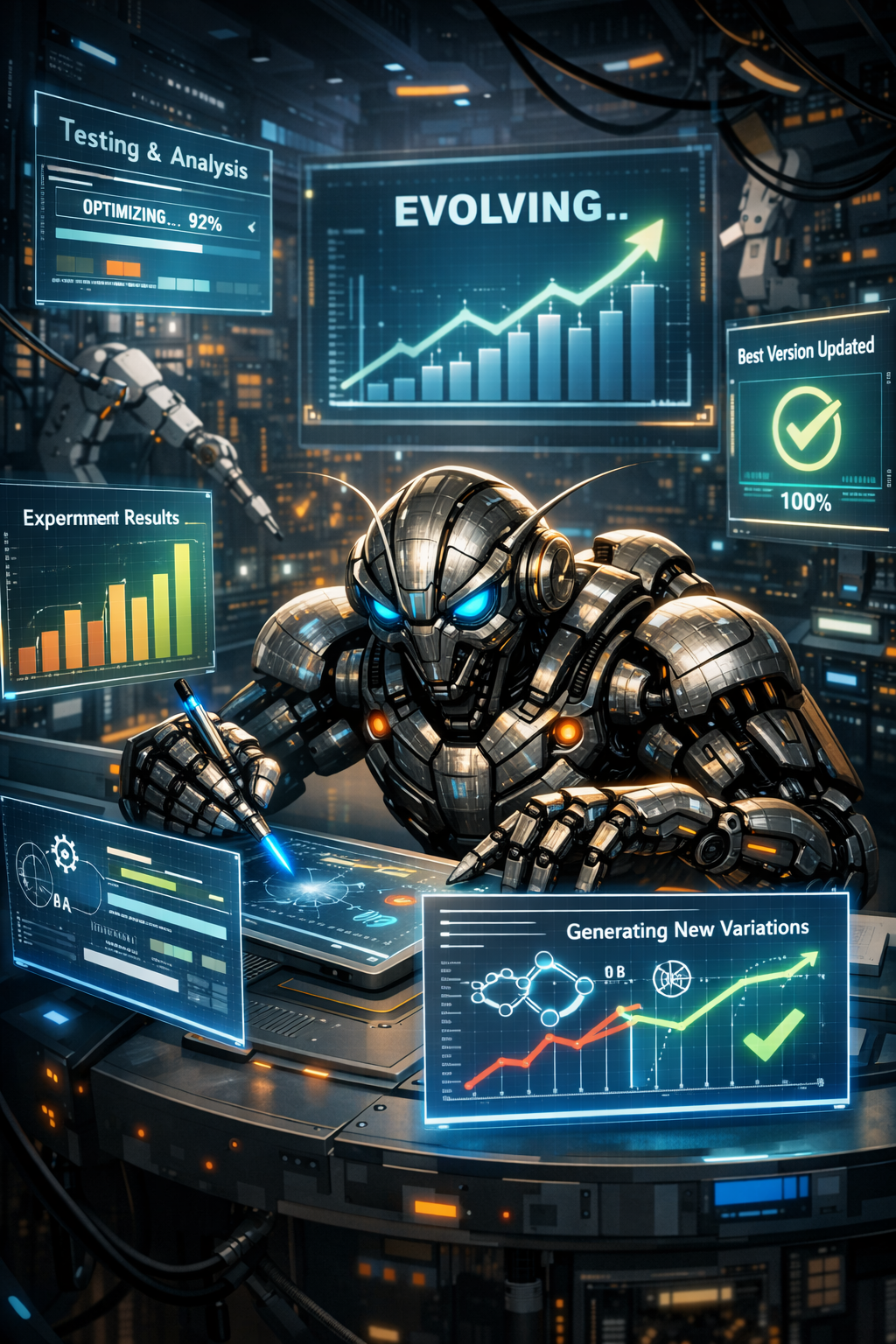
The system runs experiments automatically. It proposes a change, runs a test, measures the outcome, and keeps the improvement if it works. Then it repeats the process again. And again. All night if necessary.
In other words, the scientific method runs on autopilot.
At first glance this looks like a tool for AI researchers, a clever way to test machine-learning ideas more quickly. But after sitting with the concept for a while, I began to see something broader. What Karpathy built is really a demonstration of a pattern—one that applies to nearly every organization trying to improve something.
And improvement is what businesses spend most of their time doing.
The Hidden Constraint Inside Most Companies
Every company experiments.
Marketing teams test headlines and campaigns. Product teams test features and onboarding flows. Sales teams test messaging, pricing, and outreach strategies. Operations teams test new processes and systems.
But most businesses run experiments slowly.
An idea surfaces. Someone builds a test. The company waits for data. Weeks or months pass. Results are reviewed. A new idea replaces the old one, and the cycle begins again.
Even disciplined organizations may only run a few meaningful experiments in a quarter.
That pace felt reasonable when the tools were slow and data was scarce. But today the constraint is no longer the market or the technology. The constraint is the speed at which organizations can learn.
And that is where things begin to change.
The Experiment Loop
The core mechanism behind Karpathy’s project is simple enough to sketch on a whiteboard:
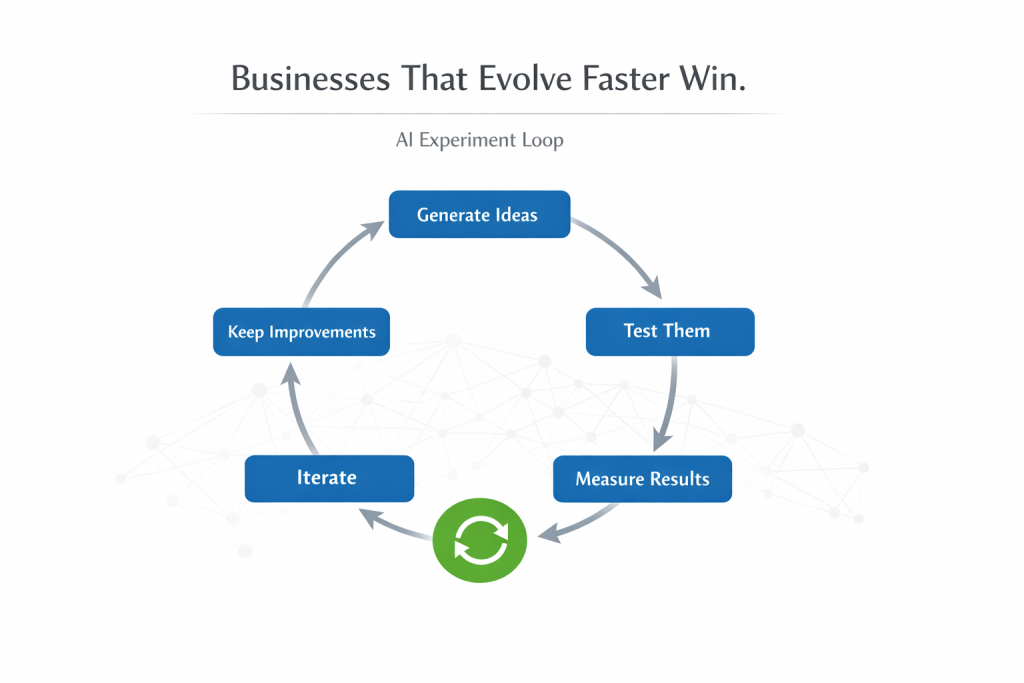
Nature uses this process to evolve life. Small variations occur, the environment tests them, and the strongest adaptations survive.
It turns out that businesses work much the same way.
When a company improves a marketing campaign, redesigns a product, or refines a pricing model, it is essentially running a controlled evolutionary process. Ideas compete. Results determine which survive.
The difference now is that machines can run this process continuously.
Marketing as an Evolutionary System
Marketing is perhaps the easiest place to see this shift.
Traditionally, a team might spend weeks designing a campaign. They debate headlines, tweak creative, launch the campaign, and then watch the data slowly arrive.
But imagine a system that generates dozens of variations automatically. Different headlines. Different images. Different landing pages. Instead of guessing which version might work best, the system deploys them all in small experiments and measures the results.
The best performers survive. New variations evolve from those winners. The cycle continues.
After hundreds of iterations the campaign looks very different from where it started. Not because someone guessed correctly, but because the system learned what the market responded to.
Over time the marketing begins to resemble something alive—constantly adapting, constantly improving.
Product Development at Machine Speed
The same principle applies to product design.
Most companies follow a familiar rhythm: build something, release it, gather feedback, and improve it in the next version. This process works, but it moves at human speed.
AI systems introduce a different possibility. They can test variations continuously.
One onboarding flow versus another. One pricing model versus a different structure. One interface layout versus another arrangement of information.
Instead of debating which option seems best in a conference room, the system quietly tests them in the real world. The data decides.
The product evolves.
The Quiet Advantage
Any part of a business that produces measurable outcomes can be improved this way.
Sales outreach can test messaging. Pricing can evolve toward higher conversion and revenue. Customer support workflows can refine themselves toward faster resolution times.
The structure is always the same: generate ideas, test them, measure results, and iterate.
Companies that build systems capable of running this loop continuously gain a quiet but powerful advantage. They learn faster than their competitors.
And in business, learning speed is often the ultimate differentiator.
A Shift in Management
As these systems become more common, the role of leadership changes slightly.
Managers will spend less time running individual experiments and more time designing the environment in which experiments occur.
They will define the objectives. Set the metrics. Establish the boundaries within which the system can explore.
The machines run the iterations.
Humans guide the direction.
Together they form a feedback loop that improves far more quickly than either could alone.
The Companies That Learn Fastest
Looking back, many of the great business advantages in history came from organizations that learned faster than their peers.
The early adopters of manufacturing automation.
The companies that mastered supply chains.
The firms that understood the internet before everyone else.
Each gained leverage by improving more quickly than competitors.
AI-driven experimentation may represent the next version of that advantage.
Companies that build systems capable of running thousands of small experiments—quietly refining marketing, pricing, product design, and operations—will accumulate improvements faster than organizations that rely on occasional strategic decisions.
Small improvements compound.
Eventually the gap becomes visible.
A Thought for Leaders
The interesting question for business leaders is not whether AI will change their industry. That answer is already clear.
The better question is this:
Where inside my organization could experimentation run continuously?
Marketing?
Product design?
Pricing?
Customer acquisition?
Operational workflows?
Once you begin looking through that lens, opportunities appear everywhere.
The future may belong to companies that don’t simply work harder or even smarter.
It may belong to companies that learn faster than anyone else.
And now, for the first time, that learning might continue long after everyone in the office has gone home.
Originally published at bramscher.com.